DO CIVIL & CLASS ACTION LAWSUITS HURT YOUR SHAREHOLDERS? DO PATENT LITIGATIONS ERODE YOUR COMPANY’S REPUTATION? DO INVESTORS VIEW YOUR COURTROOM ENGAGEMENTS AS A SIGN TO DUMP YOUR STOCK? OR ARE LEGAL CASES SIMPLY MUCH ADO ABOUT NOTHING WITH NO EFFECT ON YOUR STOCK PRICES?
There is Butch Cassidy and there is Walmart. Much talked about and forced to run the gauntlet of protectors of the legal system, the similarities are strong. There is a difference though. As much as Cassidy enjoyed biking around on Wyoming’s mountainous curves with the Sundance Kid, keeping his shirt collar a good distance from the Sheriff’s grasp, Walmart is a behemoth that does not mind sauntering down the courtroom corridors. Its autobiography is strewn with litigations. But isn’t this bad logic, to be a target of and to be a propagator of various lawsuits?
Walmart is the poster boy of the retail revolution, and the #1 2010 Fortune 500 giant. Against Walmart, the cases have covered various spaces – not paying suppliers on time, gender discrimination, failure to dole-out fringe benefits to parttimers, deliberate selling of low-quality items, unfair remuneration and promotion- related policies, paying low wages (a lawsuit filed in 2001 stated that the average wage for a Walmart sales attendant was $13,861 a year, while the federal poverty line for a family of three was $14,630), environment-related and other accusations by government agencies et al. Suing the Bentonville retailer has become a wholesale affair, with the average count of lawsuits filed against it, touching 5,000 per year (as per a Forbes report). But how much of a difference have the aspiring attorneys and plantiffs made to the reputation and earnings of Walmart?
Numbers are proof. Yes, since 2001, the company has paid more than $2.5 billion in lawsuit settlements. But the parallel tale is that during the same decade, while the company has opened 4,266 new outlets in 16 countries around the world, the company’s m-cap has increased by $6 7.54 billion. As far as revenues go, the figures have improved 155.67% (despite two downturns since FY2000) to touch $421.85 billion (FY2010). The forecasts are bright. The company is fast approaching the $500 billion sales-barrier, with estimates of $439.81 billion and $461.86 billion for FY2011 & FY2012 respectively (as per Thomson Financial). Truth is: the company has grown from strength to strength despite umpteen disputes. And it has not been a strategy of hiding in a blanket of silence. The company is combining the wave of allegations with a strong focus on marketing and advertising to maximise opportunities to turn ‘negative’ headlines into huge recall exercises. Imagine this – every single day of FY2010, on average, the company spent $65.75 million on advertising, marking an increase of 14% y-o-y. Little wonder that the retailer is up for a better 2011 & 2012, with buyers across America and the world indoctrinated to the Walmart culture.
As for those who believe that legal affairs raise questions about a firm character, here is a correction: they don’t. Had litigations mattered, the percentage of American households visiting Walmart would never been as high as 83% (in FY2010). Had litigations mattered, the company-in-question would have always seen its stock crash on news of civil or class action charges. Well, it does not occur in that manner.
On June 19, 2001, six Walmart employees from California, Illinois, Ohio, Texas & Florida filed a nationwide gender discrimination class action lawsuit against it. The charge brought together about 1.5 million former and present employees, and was meant to be the biggest class action suit against any company in American history, with damage claims running into billions of dollars. That day, the Walmart stock closed 0.69% higher. It gained a further 3.41% the next trading session. The case was last heard by the Supreme Court on March 29, 2011. And despite expectations of a multi-billion dollar setback to Walmart, the stock saw a rise of 0.13% the day before the hearing date. Though it is hard to also understand why the stock rose just 0.15% on April 1, 2011 (the day the Supreme Court ruled that the class action case against Wal-Mart must be reversed), we may safely assume that courtroom engagements (involving well known corporate brands) have little say in describing negative market sentiments for their stocks.
Here is what Larry McQuillan, Director, Pacific Resource Institute explains in a report titled, Wal-Mart Stands Up To Wave Of Lawsuits: “Fighting lawsuits makes the most long-term sense. Thetrial bar’s strategy against corporate America up to now has been to file a suit and bring the company to the table to get a settlement out of it. Wal-Mart has been a leader in not bowing to those pressures, unlike many companies that are afraid of bad publicity and want to settle. If you don’t defend yourself early on, and be persistent, you will be steamrolled.” Adds Prof. Kathryn Harrigan of Columbia Business School, “I would litigate everything. And if in the end the law made me do something, I’d fight to make sure my competitors had to do it as well. Shareholders shouldn’t be overly concerned about litigation exposure, because it’s a small price to pay.”
This one instance is not the only encouraging spotlight for shareholders in a seemingly apocalyptic wasteland. 596 pharmacists in Colorado won $45 million in damages against the discount retailer on May 9, 2003. When trading closed that day, the stock had appreciated by 1.43%. On Dec. 22, 2005, the Alameda County Superior Court in Oakland, California slapped a fine of $172 million against Walmart for violating a State law. The stock rose 0.23% that day. On Dec. 3, 2009, a Boston court stuck up a $40 million bill on Walmart’s front door. Stock price change: a positive 0.89%.
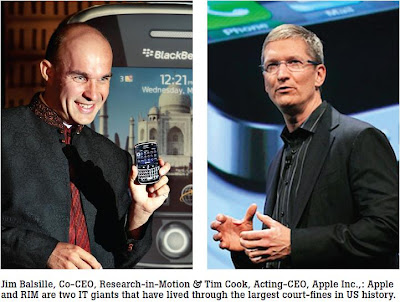 There are other Al Capones too. Courtroom battles in the world of technology are common. Apple Inc., knows that well. It has been involved in many patent infringement cases over the past decade – both as an accused and as the plaintiff. From paying up The Beatles $26.5 million and deciding to stay out of the music industry on December 8, 1991(till it launched the iTunes), to selling faulty MacBook LCD screens and iPads with battery that had overheating issues, it has taken it well. Rather, too well. And the investors are the happiest lot. From the time Steve Jobs returned to Apple in late 1996, the company’s Mcap has increased by 10,039.68% to touch $314.33 billion (as on April 5, 2011). And the rise has happened during a period when it has been busy being slammed with court papers by companies like Cisco (on Jan. 10, 2007, for infringing upon and copying and using Cisco’s registered iPhone trademark, a day after Jobs revealed Apple’s new bet, the iPhone; the Apple stock gained 4.07% that day), Nokia (for infringing on Nokia’s patents in virtually all of its mobile phones, portable music players and computers; two complaints, of which the last was on Mar. 29, 2011 – stock rise of 0.16%), Xerox (sued on April 10, 1990, for stealing Xerox’s GUI technology, which gave birth to Apple’s then-best-selling Macintosh PC – stock gain of 3.32%) et al. Apple has not been a silent observer either. Its cases against Nokia, HTC (on March 2, 2010, Apple sued HTC over 20 patent infringements with regards to its iPhone; HTC fired back by claiming that Apple had violated five patents), Microsoft (ruling given against Apple on September 1994, in a case where Apple tried to prevent Microsoft and HP from using GUI elements), and many more are proof that litigation is only a part of the larger brand-building process meant to be accepted with a spirit of more youthful optimism.
Not convinced yet? Here’s the big bite. On Oct. 1, 2010, the US Eastern District of Texas held up a $625.5 million damages claim against Apple (for violating digi-tech patents held by Mirror Worlds) - the 4th largest patent verdict passed in US history & the largest for 2010. It was meant to send the Apple stock plunging. Quite the contrary happened. When markets opened the next week, within two trading sessions, the stock gained 3.70% – an m-cap gain of $9.49 billion.
After a long-drawn battle of 4 years, BlackBerry-maker RIM was forced to pay-up $612.5 million on March 3, 2006, by a US court to NTP Inc. (one of the earliest patent-holders of wireless email). The sum was meant to settle a dispute over RIM’s email service made available for its 3 million users. The verdict then was supposed to not just bring RIM into the scanner of many watchdogs, it was also predicted to put an end to the entire Black Berry network in US and raise questions on its future. This is what appeared in an online Fortune article post the verdict, “The price of RIM’s shares was halted at $72.00 at 4:37 pm in anticipation of the announcement. RIM’s stock price soared after shares began trading after-hours, reaching as high as $86.30 in after-hours trade.” RIM’s mcap had risen by $2.65 billion (19.86%) to touch $15.97 billion when the day ended. If such huge courtroom verdicts were destined to reduce citadels to dust, RIM would have been much smaller than it is today. Perhaps gone. The reality is different. Its user base in 4 years has swollen by 1733% to 55 million and its m-cap has risen to at $28.79 billion.
 There seems to be a common belief that involvement in lawsuits will “always” lead to negative returns for shareholders and a poor financial reporting. Untrue. Prof. David Yermack of Stern School of Business (NYU) & Prof. S. Dahiya of Georgetown University, in their paper titled, Litigation Exposure, Capital Structure, and Shareholder Value, while analysing the case of value creation and destruction in the tobacco industry, concluded how companies have gained in the past by following a strategy of radical litigation. They took the case of Brooke Group CEO Bennett LeBow, who believed that civil suits had positive outcomes. The paper concludes, “Brooke Group had a tiny market share, low margins, high leverage, and highly concentrated management ownership. Beginning in 1996, the firm reached settlements in lawsuits brought by class action plaintiffs and US state governments. These events led to impressive returns for shareholders of Brooke Group.”
Even in the case of a shareholder litigation (which is considered the most vicious of all litigation types), as Prof. Georgi D. Kaltchev of International University College (Bulgaria) proves, the probability of shareholder wealth falling is low. In his November 2009 paper titled, Securities litigation and stock returns, Kaltchev proves how his hypothesis “that shareholder litigation announcements negatively affect stock returns, only finds partial support.” As per him, in more than 67% of the cases, wealth is not lost.
If the company involved in litigation adopts a heavy PR, advertising and marketing strategy (Promotion, Price & Place of 5Ps, like Walmart did by saving theaverage American household $2,500, as per Global Insight), allows innovation (Product of 5Ps, like Apple) to overshadow competition and targets the right segment (Positioning of 5Ps, like BlackBerry), litigation and court cases will only play in favour of the accused.
For companies that earn their bread and butter in the IT space, lack of innovation and absence of right positioning is poison. Why is it that Microsoft and Dell have lost tremendous value in the market, even when they have been quick to move to new emerging markets? Blame their stalled innovation engines, not litigation. About 10 years back (January 3, 2000), Microsoft was the most valuable company in the world with an m-cap of $466 billion. Then, besides 500-odd court cases, a series of innovation hiccups occurred. The Vista failed, the ‘Courier’ tablet idea planned for launch in early 2009 was dumped, its entry into the handset hardware market with the Kin was a disaster, the Zune music player was also an out-and-out failure, and its Windows software for smartphones is still scouting for a credible platform.
Of course, its SQL Server has made news, but then, what’s so innovative about a database server when everyone has already started talking about cloud computing? For Microsoft, the litigations (for lack of innovations to advertise about!) have played against investor sentiments. Litigations do prove how any company is still trying to test out something new.
That’s good. But when you keep the investors guessing forever, you’re in trouble. Like Microsoft, which has lost 53.52% of its value since 2000, Dell & Motorola are no different. From m-caps of $111 billion & $56 billion a decade back, the companies are today valued at $27.51 billion & $14.87 billion – reductions of 75.22% & 73.45% respectively.
Pharmaceutical companies over decades have been known to live through patent infringement lawsuits. The count of these increased from 81 in FY2005 to over 243 in FY2010. During the same period, generic players (which were taken to court by Big Pharmas), have won 70% of the cases – which directly translates to $60 million in revenues during the first six months for the generic players. This gain, after spending $5 million on an average on each challenge, sounds quite a deal. As new drug development pipelines are drying up, with no new blockbuster in sight till at least 2015, the next three-four years will witness many more litigations, where it could mean an increasing count of generics suing generics! In short – the lawsuits will get to you sooner than you thought. Gear up.
There is a joke which does the rounds in America. After the Feds, it’s Walmart which gets the maximum summons. It’s true. Consider this; how many will be surprised if you told them that companies in the technology & telecom industry are the ones sued the most (with drug makers at #2)? My guess is – none. And my advise is, ride on the opportunities. This time, they come in the name of litigations. If the courtroom-savvy-employee- whipping Walmart can, if the patentinfringing- Xerox GUI-stealing Apple can, so can any other company. Advertise, innovate, grow, and don’t you worry about litigations. They never could catch even Al Capone on that.
There is Butch Cassidy and there is Walmart. Much talked about and forced to run the gauntlet of protectors of the legal system, the similarities are strong. There is a difference though. As much as Cassidy enjoyed biking around on Wyoming’s mountainous curves with the Sundance Kid, keeping his shirt collar a good distance from the Sheriff’s grasp, Walmart is a behemoth that does not mind sauntering down the courtroom corridors. Its autobiography is strewn with litigations. But isn’t this bad logic, to be a target of and to be a propagator of various lawsuits?
Walmart is
 the poster boy of the retail revolution, and the #1 2010 Fortune 500 giant. Against Walmart, the cases have covered various spaces – not paying suppliers on time, gender discrimination, failure to dole-out fringe benefits to parttimers, deliberate selling of low-quality items, unfair remuneration and promotion- related policies, paying low wages (a lawsuit filed in 2001 stated that the average wage for a Walmart sales attendant was $13,861 a year, while the federal poverty line for a family of three was $14,630), environment-related and other accusations by government agencies et al. Suing the Bentonville retailer has become a wholesale affair, with the average count of lawsuits filed against it, touching 5,000 per year (as per a Forbes report). But how much of a difference have the aspiring attorneys and plantiffs made to the reputation and earnings of Walmart?
Numbers are proof. Yes, since 2001, the company has paid more than $2.5 billion in lawsuit settlements. But the parallel tale is that during the same decade, while the company has opened 4,266 new outlets in 16 countries around the world, the company’s m-cap has increased by $6
 7.54 billion. As far as revenues go, the figures have improved 155.67% (despite two downturns since FY2000) to touch $421.85 billion (FY2010). The forecasts are bright. The company is fast approaching the $500 billion sales-barrier, with estimates of $439.81 billion and $461.86 billion for FY2011 & FY2012 respectively (as per Thomson Financial). Truth is: the company has grown from strength to strength despite umpteen disputes. And it has not been a strategy of hiding in a blanket of silence. The company is combining the wave of allegations with a strong focus on marketing and advertising to maximise opportunities to turn ‘negative’ headlines into huge recall exercises. Imagine this – every single day of FY2010, on average, the company spent $65.75 million on advertising, marking an increase of 14% y-o-y. Little wonder that the retailer is up for a better 2011 & 2012, with buyers across America and the world indoctrinated to the Walmart culture.
As for those who believe that legal affairs raise questions about a firm character, here is a correction: they don’t. Had litigations mattered, the percentage of American households visiting Walmart would never been as high as 83% (in FY2010). Had litigations mattered, the company-in-question would have always seen its stock crash on news of civil or class action charges. Well, it does not occur in that manner.
On June 19, 2001, six Walmart employees from California, Illinois, Ohio, Texas & Florida filed a nationwide gender discrimination class action lawsuit against it. The charge brought together about 1.5 million former and present employees, and was meant to be the biggest class action suit against any company in American history, with damage claims running into billions of dollars. That day, the Walmart stock closed 0.69% higher. It gained a further 3.41% the next trading session. The case was last heard by the Supreme Court on March 29, 2011. And despite expectations of a multi-billion dollar setback to Walmart, the stock saw a rise of 0.13% the day before the hearing date. Though it is hard to also understand why the stock rose just 0.15% on April 1, 2011 (the day the Supreme Court ruled that the class action case against Wal-Mart must be reversed), we may safely assume that courtroom engagements (involving well known corporate brands) have little say in describing negative market sentiments for their stocks.
Here is what Larry McQuillan, Director, Pacific Resource Institute explains in a report titled, Wal-Mart Stands Up To Wave Of Lawsuits: “Fighting lawsuits makes the most long-term sense. Thetrial bar’s strategy against corporate America up to now has been to file a suit and bring the company to the table to get a settlement out of it. Wal-Mart has been a leader in not bowing to those pressures, unlike many companies that are afraid of bad publicity and want to settle. If you don’t defend yourself early on, and be persistent, you will be steamrolled.” Adds Prof. Kathryn Harrigan of Columbia Business School, “I would litigate everything. And if in the end the law made me do something, I’d fight to make sure my competitors had to do it as well. Shareholders shouldn’t be overly concerned about litigation exposure, because it’s a small price to pay.”
This one instance is not the only encouraging spotlight for shareholders in a seemingly apocalyptic wasteland. 596 pharmacists in Colorado won $45 million in damages against the discount retailer on May 9, 2003. When trading closed that day, the stock had appreciated by 1.43%. On Dec. 22, 2005, the Alameda County Superior Court in Oakland, California slapped a fine of $172 million against Walmart for violating a State law. The stock rose 0.23% that day. On Dec. 3, 2009, a Boston court stuck up a $40 million bill on Walmart’s front door. Stock price change: a positive 0.89%.
 There are other Al Capones too. Courtroom battles in the world of technology are common. Apple Inc., knows that well. It has been involved in many patent infringement cases over the past decade – both as an accused and as the plaintiff. From paying up The Beatles $26.5 million and deciding to stay out of the music industry on December 8, 1991(till it launched the iTunes), to selling faulty MacBook LCD screens and iPads with battery that had overheating issues, it has taken it well. Rather, too well. And the investors are the happiest lot. From the time Steve Jobs returned to Apple in late 1996, the company’s Mcap has increased by 10,039.68% to touch $314.33 billion (as on April 5, 2011). And the rise has happened during a period when it has been busy being slammed with court papers by companies like Cisco (on Jan. 10, 2007, for infringing upon and copying and using Cisco’s registered iPhone trademark, a day after Jobs revealed Apple’s new bet, the iPhone; the Apple stock gained 4.07% that day), Nokia (for infringing on Nokia’s patents in virtually all of its mobile phones, portable music players and computers; two complaints, of which the last was on Mar. 29, 2011 – stock rise of 0.16%), Xerox (sued on April 10, 1990, for stealing Xerox’s GUI technology, which gave birth to Apple’s then-best-selling Macintosh PC – stock gain of 3.32%) et al. Apple has not been a silent observer either. Its cases against Nokia, HTC (on March 2, 2010, Apple sued HTC over 20 patent infringements with regards to its iPhone; HTC fired back by claiming that Apple had violated five patents), Microsoft (ruling given against Apple on September 1994, in a case where Apple tried to prevent Microsoft and HP from using GUI elements), and many more are proof that litigation is only a part of the larger brand-building process meant to be accepted with a spirit of more youthful optimism.
Not convinced yet? Here’s the big bite. On Oct. 1, 2010, the US Eastern District of Texas held up a $625.5 million damages claim against Apple (for violating digi-tech patents held by Mirror Worlds) - the 4th largest patent verdict passed in US history & the largest for 2010. It was meant to send the Apple stock plunging. Quite the contrary happened. When markets opened the next week, within two trading sessions, the stock gained 3.70% – an m-cap gain of $9.49 billion.
After a long-drawn battle of 4 years, BlackBerry-maker RIM was forced to pay-up $612.5 million on March 3, 2006, by a US court to NTP Inc. (one of the earliest patent-holders of wireless email). The sum was meant to settle a dispute over RIM’s email service made available for its 3 million users. The verdict then was supposed to not just bring RIM into the scanner of many watchdogs, it was also predicted to put an end to the entire Black Berry network in US and raise questions on its future. This is what appeared in an online Fortune article post the verdict, “The price of RIM’s shares was halted at $72.00 at 4:37 pm in anticipation of the announcement. RIM’s stock price soared after shares began trading after-hours, reaching as high as $86.30 in after-hours trade.” RIM’s mcap had risen by $2.65 billion (19.86%) to touch $15.97 billion when the day ended. If such huge courtroom verdicts were destined to reduce citadels to dust, RIM would have been much smaller than it is today. Perhaps gone. The reality is different. Its user base in 4 years has swollen by 1733% to 55 million and its m-cap has risen to at $28.79 billion.
 There seems to be a common belief that involvement in lawsuits will “always” lead to negative returns for shareholders and a poor financial reporting. Untrue. Prof. David Yermack of Stern School of Business (NYU) & Prof. S. Dahiya of Georgetown University, in their paper titled, Litigation Exposure, Capital Structure, and Shareholder Value, while analysing the case of value creation and destruction in the tobacco industry, concluded how companies have gained in the past by following a strategy of radical litigation. They took the case of Brooke Group CEO Bennett LeBow, who believed that civil suits had positive outcomes. The paper concludes, “Brooke Group had a tiny market share, low margins, high leverage, and highly concentrated management ownership. Beginning in 1996, the firm reached settlements in lawsuits brought by class action plaintiffs and US state governments. These events led to impressive returns for shareholders of Brooke Group.”
Even in the case of a shareholder litigation (which is considered the most vicious of all litigation types), as Prof. Georgi D. Kaltchev of International University College (Bulgaria) proves, the probability of shareholder wealth falling is low. In his November 2009 paper titled, Securities litigation and stock returns, Kaltchev proves how his hypothesis “that shareholder litigation announcements negatively affect stock returns, only finds partial support.” As per him, in more than 67% of the cases, wealth is not lost.
If the company involved in litigation adopts a heavy PR, advertising and marketing strategy (Promotion, Price & Place of 5Ps, like Walmart did by saving theaverage American household $2,500, as per Global Insight), allows innovation (Product of 5Ps, like Apple) to overshadow competition and targets the right segment (Positioning of 5Ps, like BlackBerry), litigation and court cases will only play in favour of the accused.
For companies that earn their bread and butter in the IT space, lack of innovation and absence of right positioning is poison. Why is it that Microsoft and Dell have lost tremendous value in the market, even when they have been quick to move to new emerging markets? Blame their stalled innovation engines, not litigation. About 10 years back (January 3, 2000), Microsoft was the most valuable company in the world with an m-cap of $466 billion. Then, besides 500-odd court cases, a series of innovation hiccups occurred. The Vista failed, the ‘Courier’ tablet idea planned for launch in early 2009 was dumped, its entry into the handset hardware market with the Kin was a disaster, the Zune music player was also an out-and-out failure, and its Windows software for smartphones is still scouting for a credible platform.
Of course, its SQL Server has made news, but then, what’s so innovative about a database server when everyone has already started talking about cloud computing? For Microsoft, the litigations (for lack of innovations to advertise about!) have played against investor sentiments. Litigations do prove how any company is still trying to test out something new.
That’s good. But when you keep the investors guessing forever, you’re in trouble. Like Microsoft, which has lost 53.52% of its value since 2000, Dell & Motorola are no different. From m-caps of $111 billion & $56 billion a decade back, the companies are today valued at $27.51 billion & $14.87 billion – reductions of 75.22% & 73.45% respectively.
Pharmaceutical companies over decades have been known to live through patent infringement lawsuits. The count of these increased from 81 in FY2005 to over 243 in FY2010. During the same period, generic players (which were taken to court by Big Pharmas), have won 70% of the cases – which directly translates to $60 million in revenues during the first six months for the generic players. This gain, after spending $5 million on an average on each challenge, sounds quite a deal. As new drug development pipelines are drying up, with no new blockbuster in sight till at least 2015, the next three-four years will witness many more litigations, where it could mean an increasing count of generics suing generics! In short – the lawsuits will get to you sooner than you thought. Gear up.
There is a joke which does the rounds in America. After the Feds, it’s Walmart which gets the maximum summons. It’s true. Consider this; how many will be surprised if you told them that companies in the technology & telecom industry are the ones sued the most (with drug makers at #2)? My guess is – none. And my advise is, ride on the opportunities. This time, they come in the name of litigations. If the courtroom-savvy-employee- whipping Walmart can, if the patentinfringing- Xerox GUI-stealing Apple can, so can any other company. Advertise, innovate, grow, and don’t you worry about litigations. They never could catch even Al Capone on that.


 There are many names which surface in this debate of a mismatch between executive compensation and performance in the modern world. The fourth largest US corporation (in terms of revenues for 2009), General Electric, is one. When Jeffrey Immelt took over as CEO on September 7, 2001, everyone was hopeful. He was handpicked by Jack Welch, to lead GE into becoming the new global powerhouse conglomerte of the new millennium. GE was then valued at $415 billion, and was comfortably ahead of the #2 Microsoft (which stood at $335 billion). The company’s stock was trading at $42 a share on the NYSE. Under Immelt, the company has lost half its value (m-cap of $216.4 billion - a fall of 47.9%), and its share trades at just 48.5% of the level at which it did a day before he assumed office. The mistakes he made could be described as “basic” as far as Welch was concerned. Welch had made it clear that a GE CEO had only two tasks – allocate the right amount of capital in the right places, and choose the right people. Talk to GE trackers, and they point to two critical mistakes that Immelt has made all through his term. Those very two.
 When Immelt took over, GE had $42 billion of capital invested in it. By 2009, this had increased to more than $163 billion. The problem was: GE Capital (GEC – which was Immelt’s top bet) had also borrowed hundreds of billions separately. What spoiled the party was that, with GE Capital under-performing, the return fell much below the cost. And the value destroyed is there for the world to see. Immelt had bet too big on making GE a “diversified financial entity”. After many wrong acquisitions and untimely investments on businesses of the future (like green energy), today, GE carries a debt load of half-a-trillion dollars – 232.9% more than its FY2010 topline. So how does GE reward Immelt? Actually, he has earned quite a gunny bagful.

