Friday, August 12, 2011

DOES HAVING TWO CO-CEOS WORK FOR A COMPANY?

HOW GOOD IS A CO-CEO FOR A COMPANY’S SALES, PROFITS, MARKETSHARE, AND SHAREHOLDERS? I FOUND OUT THE ANSWERS, AND WASN’T AT ALL SURPRISED...

In the weeks that followed the first signs of infertility in the US home mortgage market in the new century, panic gripped boardrooms in America Inc. According to the US Government’s Department of Commerce, these dates correspond to the Aug-Sept months of Q3, 2008. Then, the shock was expected, accepted and came with reasons. [Till Q3, 2009, the US economy continued going downhill with GDP growth recorded in the four quarters leading to Q3, 2009: -2.7%, -5.4%, -6.4% and -0.7%]. Corporations which till then had been a symbol of America shining, had fear in their minds – they wanted to avoid losing the pounds gained since 2001. And those who had been doing quite the opposite, sensed a threat to their very existence. One of them was Motorola.

CEOs

(L-R, starting opposite page): Sanjay Jha (CEO, Motorola Mobility Solutions) & David Brown (CEO, Motorola Solutions) – co-CEOs whose roles and divisions were split after an initial failed start; Anshu Jain & Jurgen Fitschen (Co-CEOs of Deutsche Bank) – an unwelcoming reaction from the stock market on their appointments; and Mike Lazaridis & Jim Balsillie (co-CEOs of the troubled Research-In-Motion) – who will go first?


Motorola then, had become a shadow of its glorious past. Between 1994 and mid- 2008, Motorola’s global market share in the mobility devices market had plummeted from 45% to 9.5% (Gartner). The company had clearly missed the leap from analog to digital. It failed to introduce digital phones, missed out on customer interests when their attention turned towards more software-than-hardware handsets, and its plodding culture and bureaucracy within the ranks resulted in non-exciting launches in the decades leading to 2008 (except for the RazR). At the company – largely regarded as a victim of innovator’s dilemma – cancellation of projects and firing became the order of the day. Finally, after having lost 76.29% of its m-cap since Jan 2000 (from $109.14 billion on Jan 2, 2000 to $25.88 billion on Aug 3, 2008), on Aug 4, 2008, it planned a boardroom surgery. Two men were chosen to rule the fast-disappearing island kingdom and better what Edward Zander had tried with the RazR launch. Sanjay Jha and Greg Brown were the two co-CEOs. The move backfired.

Since Motorola became a victim to the co-CEO leadership practice, its decline accelerated. Until Q4, 2010, the company’s share in the worldwide mobile market – despite an 888.8% rise in sales of Android handsets (which was Motorola’s bet) – had fallen to 2.1%. And how did the co-CEOs do worse for the company than the much criticised authoritarian-andbureaucracy- promoting CEO Zander? While under Zander (between Jan 2004 and Jan 2008), the company had gained 1.2% in market share (to touch 17.5% for Q4, 2007), with its m-cap too appreciating by 24.0% to touch $39.01 billion (as on Dec 31, 2007), under the two co- CEOs, within just a year-and-a-half (between Q3, 2008 and Q4, 2010), the company besides losing 7.4% of the global market share, eroded more than half (55.56%) of their shareholders’ wealth – to touch a lowly $9.26 billion as on December 31, 2010. While everyone – from a near-dead HTC to the ever declining Nokia – moved ever so swiftly to capture opportunities in the 4G market, Motorola, under the duo remained every so dedicated to its engineering and careful to market culture [rather, slow – proof is the delayed launches of its Droid Bionic and Xoom 4G update]. This co-CEO arrangement suffered from delays in decision- making. In an interview with BusinessWeek, Jha had confessed that he takes about “90 days to assess a situation before taking any final decision.” Naturally, much time is spent in convincing the other co-CEO – Brown. 90 days to take any call in the world of mobility beats any logic. The Economist, in a Mar 2010 piece titled, ‘The Trouble with Tandems’, puts the problem with co-CEOs theory rightly: “Joint stewardships are all too often a recipe for chaos. Rather than allowing companies to get the best from both bosses, they trigger damaging internal power struggles as each jockeys for the upper hand. Having two people in charge can also make it tougher for boards to hold either to account. At the very least, firms end up footing the bill for two CEO-sized pay packets.”
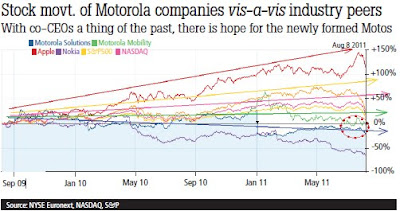
Stock Movement of Motorola

The shareholders at Motorola (led by Carl Icahn), having finally realised that this joint-leadership is doing no good to them, split Motorola into two separate companies in Jan 4, 2011 – Motorola Solutions (headed by CEO Brown) and Motorola Mobility Holdings (headed by CEO Jha). Going by the financials during the two bygone quarters, it appears that both the companies are en route to safety. After losing $4.29 billion in FY2008 & FY2009, within seven months of the split in roles, it is quite visible that the move is working – the combined net m-cap of the two firms have reached $19.92 billion (a rise of 115.12%), and the two companies have also become more profitable (with a 206.93% y-o-y increase in PAT for H1, FY2011 to touch $709 million). Motorola invented the 6-sigma more than two decades back. It can’t have two CEOs in the name of ensuring quality, and missing out on timely meeting consumer demands. One CEO on top will do.
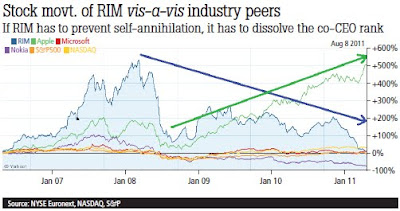

Stock Movement of RIM

Trouble in cases where joint bosses are calling the shots, is not rare. The most recent instance being that of RIM which is led by co-Chairmen and co-CEOs Mike Lazaridis and Jim Balsillie. While Balsillie is the techie, Lazaridis is the salesguy. This combination was supposed to bring out the best in RIM. It has not. Considered to be amongst the biggest threats to Apple and Nokia, RIM’s co-CEOs structure has succeeded, but only so far as to please its small target audience with handsets that lack variety. Three years back, RIM’s mcap stood at an all-time high of $73.47 billion (Q2, FY2008). Since then, RIM has lost 84.14% in m-cap and is today, worth only $11.65 billion. In fact, over just the last five months, with delays in the launch of its tablet Playbook (and the poor reviews) the company’s share price has fallen by 65.5%. RIM in Q1, 2011, lost 5.1% of its global market share y-o-y (which fell to 14%). On the other hand, Apple (rise of 3% to 18.7%), Samsung (+6.5%; 10.8%), and even HTC (+4%; 8.9%) grew their respective pies. And the future? Both IDC and Gartner have bad news for RIM, whose market share is forecasted to fall to a lower 13% by 2015. For others, the picture is pretty. Android (43.8%), Apple iOS (19.9%), the Nokiasaviour Windows Phone 7 (20.3%) are set to rise further. So where lies the rub? Industry experts claim that RIM is not making a bad product. It is only that the company is not delivering what customers want to pay for. And this is where the two co-CEOs are finding hard to match their thoughts. Lazaridis would prefer selling something unique and mass-pleasing, while Balsillie does not seem too confident about RIM representing simple technology. A case in point of this company making a product unnecessarily complicated is the Playbook tablet. Why on earth would any user want to link his tablet to his smartphone to even send an email? Again, time is lost, and the worst case scenario is right in front of the world. Smartphones with no innovation, tablets that are not selling for the right reason (at present, what RIM is selling is a half-baked tablet, on which there is no email app, no calendars, no notes app et al), and two co-CEOs whose performance cannot be questioned as they are also the co-Chairmen of the Board of Directors of RIM. Balsillie should step down and perhaps assume the role of the CTO and Laziridis should continueas the sole CEO and not allow geeks to force him to sell engineering feats that do not help win customers’ dollars. What RIM needs to do fast is to make rapid, incremental alterations to its hardware, software, and platform products. If it does not, it only risks giving up the high-end status cult-crown, and will over time, slip in the priority lists of carriers, and witness a constant fall in margins. Remember: Palm was also once a smartphone leader, but is today, almost nowhere on the charts. RIM can become the second Palm. Balsillie cannot even blame any lack in R&D dollars for not getting his products right. Warren Buffett once wrote in one of his book titled, ‘On the Interpretation of Financial Statements’, that, “If a company has to spend more than a certain percentage of its gross profit on R&D, its competitive advantage cannot be sustained...” According to him, that percentage is 15%. RIM spent 15.86% of its gross profits in R&D last year (FY2010-11). See where the problem is? The geek co-CEO is burning cash, while the salesguy co-CEO is only getting complex stones to sell! Summing up the solution, Rick Wartzman, Executive Director of the Drucker Institute at California- based Claremont Graduate University writes in a BusinessWeek article titled, ‘RIM’s Prickly Board Problem’, “Some governance experts have long suggested that a good way to foster the kind of independence Drucker advocated is to have one individual acting only as CEO and another individual acting strictly as Chairman of the board. Indeed, over the past 25 years, the trend toward dividing these jobs has accelerated, so that 40% of S&P 500 companies now follow this practice. With RIM having had trouble launching new products, its profit forecast dwindling, and layoffs mounting, the board needs to demonstrate that it understands management’s performance is nothing to phone home about.” Strange – in case of Apple, the exit of its CEO is considered a danger to the company. In RIM’s case, the opposite is true!

Other creaky seesaws with two co- CEOs promoting organisational paralysis can be seen too. Bill McDermott and JimHagemann Snabe who have been co- CEOs of SAP, since February 7, 2010, have actually been leading the least-attractive outfit in enterprise solutions business for shareholders. Even in a growing enterprise solutions market (especially after recovery started post-2010), since they took charge of SAP, the company has lost 1.93% in m-cap. In fact, during the very next session of trade post announcement that the duo would take charge of SAP, the stock grew slimmer by 5.82%. To make a quick comparison, since Feb 2010, SAP’s competitors, led by single bosses who can hardly be described as consultative or the sharing types, have done better. While tyrant- Larry Elisson’s Oracle produced a return of 13.77% during the past 17 months, the salesguy-Sam Palmisano’s IBM increased his investor’s money by 40.44%!


Stock Movement of SAP

It was the two co-Chairmen and co- CEOs Michael Klein and Tom Maheras of Citi Markets & Banking (Citi’s investment banking arm) who led the division to becoming the highest contributor to the bank’s total losses of $29.38 billion in FY2008 & 2009. When Anshu Jain was crowned co-Chairman and co-CEO of Germany’s largest bank (Deutsche Bank; alongisde Jurgen Fitschen) the stock market reacted negatively – one trading session after the announcement on Jul 26, 2011, the stock was down 3.31% to $53.77. Nine trading sessions later (Aug 8, 2011), it had shed 21.86% (at $43.41). Why such a stigma attached to co-CEOs? History is proof. Whether it be MySpace’s Jones and Hirschhorn or Wipro’s Paranjpe and Vaswani or Martha Stewart Living Omnimedia’s Millard and Marino, co-CEOs have always failed the litmus test. And quite spectacularly so. Either the company has suffered or they have been replaced (and the company still suffers!). These outcomes are summarised well by a 2010 paper titled, ‘Shared leadership: Is it time for a change’, in which Dr. Michael Kocolowski of South Florida University writes, “We are dealing with a universal myth: in the popular mind, leadership is always singular. A shared leadership issue to consider involves decision making. Since it is sometimes difficult for a more than one leader to reach consensus, decisions can take longer to make. The benefits of complementary leadership are negated when agreement about organisational priorities differ and irreconcilable differences impede decision making and forward progress.”

When the 20-feet long, 2 tonne-weighing Stegosaurus (a dinosaur that lived in the Woodlands of western North America) was first discovered in 1877, scientists were foreign to the idea of living beings with gigantic lizards & walnut-sized brains. Therefore, a palaeontologist named Othniel Marsh put forward his claim that a second brain resided in the Stegosaurus’ backside, which helped him control the back and lower part of its body. Debates continued over this extinct being that walked the Earth, 150 million years ago. But there is one lesson which this Jurassic Park-page has for today’s board of gigantic organisations that fear extinction: the second brain wherever in the body didn’t quite help Stegogaur’s fate? And it doesn’t seem to be working too well in the modern world either. There can be only one emperor to the empire. There should be only one leader in the corporation!


Share/Bookmark

Friday, July 1, 2011

SHOULD CEOs WASTE TIME ON “INTERNAL MEETINGS”?

“TOO MANY MEETINGS, TOO MUCH TIME WASTED,” IS A LAMENT ONE OFTEN HEARS WITHIN TOP AND MIDDLE MANAGEMENT. SHOULD CEOS EVEN BELIEVE IN MEETINGS?

Apple’s success is not hard to interpret. Same is the case with Steve Jobs, when you talk about anything (except a liver). After the music industry-defining iPod, the smart phone segment-winning iPhone, the tablet market-establishing iPad – “Apple=innovation” has become the new equation in the world of technology. And all this is not about to change soon. Despite the continuing dispute over Tim Cook’s competence [to fill Jobs’ shoes], the company’s shareholders have been on the right side of celebrations. Today, Apple has become a $310 billion-worth obsession for investors (m-cap on Nasdaq as on June 28, 2011; making it the 2nd-most valuable company in the world), having grown at an annualised rate (CAGR) of 45.8%, making it the fastest wealth-creating corporate entity in the world over the past decade (between January 1, 2000- January 1, 2011).

Innovation yes, but Apple is less about processes than it is about people – people who make machines, people who get fired, and people who have the final word at the end of a disguised six-sigma activity. But these are people who work in an atmosphere of discipline thrust upon them – wearing formal attire to work (unlike the bathroom slipper-and-bermuda casual culture of Adobe & Google) and compulsorily attending internal meetings. In these two respects, the black turtleneck-wearing Jobs has maintained a policy of no exception, whether it be the new recruit or his heir-apparent at Apple. It is perhaps the very reason why despite only a handful of 100 chosen employees being given the opportunity to spend a two-day workshop with Jobs in a secretive location every year, everyone across the board at Apple still breathes in an air of equality. How did Apple outgrow everyone else? [In the past decade, the company’s topline grew by 717.4% to touch $65.23 billion in FY2010, while its bottomline increased by 1677.2% to $14.01 billion.] This ruthless corporate culture that Jobs has nurtured since his return seems a mystery. Actually, it is not.

A. G. Lafely, Sam Palmisano and Steve JobsAs much as Jobs finds no justification in the logic of paying people cash for not falling ill, he is absolutely convinced that internal meetings with employees help matters regarding the company’s set goals, product lines, costs and performance. It comes in the form of marathon Monday meetings at the company’s headquarter at 1 Infinite Loop.

This is what he told Fortune magazine in February this year about how important internal meetings are to him and everyone at Apple, “So what we do every Monday is we review the whole business. We look at what we sold the week before. We look at every single product under development, products we’re having trouble with, products where the demand is larger than we can make. All the stuff in development, we review. And we do it every single week. I put out an agenda – 80% is the same as it was the last week, and we just walk down it every single week. We don’t have a lot of process at Apple, but that’s one of the few things we do just so all stay on the same page.” To understand why they are called ‘marathon meetings’, you must note that there are 21 Senior VPs at Apple who report directly to Jobs, besides others like Cook, Jony Ive and Phil Schiller – names that are familiar beyond Silicon Valley. So respecting the voice of someone like a Craig Federighi (Sr. VP, Software Engineering, who of late has been working on new feature enhancement transition for the new Mac OS X: Lion, to pump new life into the declining sales of Mac OS desktops) or a Scott Forstall (Sr. VP, iOS Software, who would always argue for a higher budget allocation to support the ongoing project to come up with a new version of iOS – the next one is iOS 5.0), would mean tens of minutes of ear-filling patience on the part of the core team. But Jobs does not mind.

He knows that his company’s report card has improved dramatically in the past decade only because he has not been scared to give news during team meetings, especially the bad ones. That’s the solution to correct things that have gone wrong or avoiding things that could.

Jobs has never shied away from dropping shells and otherwise not-so-common shockers during regular weekly meetings. Call it tradition. Name a project and you have an instance. One which everyone at Apple would remember comes to mind. One fine Monday morning in the autumn of 2007, Jobs walked into a meeting with his design team and declared, “I just don’t love this. I can’t convince myself to fall in love with this. And this is the most important product we’ve ever done. All this work you’ve done for the last year, we’re going to have to throw it away and start over, and we’re going to have to work twice as hard now because we don’t have enough time.” He was referring to the enclosure design for the first iPhone due to be launched in about a month from then. As any of the 50-odd who attended that meeting at Apple will confess forever – it was unbelievable that this man had the heart to push the reset button at such a late stage. But they all volunteered to make it possible. Result: they re-created the way the first three versions of iPhone would look.
Stock performance of Apple, IBM and other technology firmsThere is another incident which proves another aspect of Jobs’ team meetings – the bombs. CEO Jobs shouts and humiliates individuals or a group of insiders during meetings. In the summer of 2008, following the failure of MobileMe (which was supposed to become the new darling of corporate customers who loved their BlackBerrys), Jobs blasted-off the entire team that created MobileMe in the Town Hall audi in building #4 of the company’s campus. “Can anyone tell me what MobileMe is supposed to do?” Jobs asked. When someone gave a logical answer, he retorted - “So why the f#<>k doesn’t it do that?” The next 30 minutes, Jobs generously rebuked and abused the guilty lot. “You’ve tarnished Apple’s reputation.

You should hate each other for having let each other down,” said Jobs. Worse, after the verbal volley, with immediate effect, Jobs replaced the head of that project. What Jobs does is a lesson for CEOs to emulate. Hold regular meetings and punish the guilty accordingly, and publicly. Never mind the broken hearts – if it does good for your stock and your company’s coffer, sound them off! Here is the lesson: If you thought that giving the employees a stick in public was unethical, think again. That is not what successful leaders like Jobs think. Today, thanks to him, Apple is the World’s Most Admired Company for the fourth year in a row, as per Fortune’s ranking for 2011 obtained through a survey of business leaders around the world

There are other CEOs who follow the scripture that advocates internal meetings to the hilt. One of them is Sam Palmisano, the 59 year-old CEO of IBM. When Palmisano took over IBM, the Big Blue giant was losing ground fast. Revenue was declining and hardware no longer seemed the way. Keeping the long term in mind, Palmisano started engaging himself in gruelling long session with IBM’s researchers, during which he urged his employees to “track and shape the tech trends that will define the world a decade or more” later. Sweeping troubling matters under the carpet is not his style, and the proof of this is the manyhours- long discussions that he holds with IBM’s lab directors, with whom he discusses corporate strategy and the future of IBM’s technology. And to give you an idea of how unkind he can be during the interactions, his lab directors confess that showing up unprepared is the worst thing that you could do, because Palmisano values his own viewpoints.

Having shed its hardware deadweight at the right time (in 2005) despite the world opposing his move [“Services was seen as a low profit business when we got into it. We were criticised,” he tells Forbes], IBM has today become one of the only three brands in the world with a valuation in excess of $100 billion ($100.85 billion), and is the Most Admired IT Services Company in the world as per Fortune. From meeting 8,000 IBMers in Beijing’s Great Hall of the People to discussing growth with his employees at the Thomas J. Watson Research Center in New York on the company’s 100th birthday, Palmisano travels 200,000 miles a year to meet his employees. In fact, he has pumped-in the habit of meetings into the culture of IBM. While talking about uncountable pre-sales preparation meetings at IBM, Mike Karels, a former employee of IBM notes, “I cannot tell you how many meetings we had, before meeting with the customer…” IBM’s m-cap has risen by 57% since he took over. The company today is only the fourth in US with an m-cap in excess of $200 billion ($200.7 billion on Nasdaq, as of June 27, 2011). This CEO makes himself heard through what is called “meetings with staff ”, expressing both his pleasure & displeasure at will. He knows it works.

Leaders have to appreciate that even with the right team in place, leaving the organisation to prosper on autopilot sans engagement with the employees is wrong. This would mean that bosses should necessarily meet their SBU heads and other employees at least once a week (the higher the frequency the better), and give them an honest feedback on their respective performances – good or bad, encouraging or shameful. In their Fall 2007 paper titled, The CEO’s role in leading transformation, Carolyn Aiken (Consultant at McKinsey Toronto) and Scott Keller (Principal at McKinsey Chicago) conclude, “Typically, the first order of business is for members to agree on how often the team should meet, what transformation issues should be discussed, and what behaviour the team expects and won’t tolerate. Successful CEOs never lose sight of their responsibility to chair review forums. Through these, they identify the root causes of any deviations, celebrate successes, help fix problems, and hold leaders accountable for keeping the transformation on track.”

The reason why spending time interacting with employees is critical Jack Welchis because the role of a CEO is also one that of an reinforcement agent. A. G. Lafley, former CEO of Procter & Gamble (the current #5 company in Fortune’s Most Admired Companies ranking 2011) is an example. When Lafley took over in 2000, P&G was a ship sailing amidst rocks. When he handed over the baton on June 10, 2009 (to become the Chairman of the board), P&G was its powerful self again. So how did Lafley choose a new era over a lost decade? A hard taskmaster, Lafley has always been an advocate of employee engagement through meetings and one who has used words of praise and denigration alike. After the initial meetings with existing employees, Lafley understood that he had to re-do the consumers- employees-shareholders loop and alter management and cost structure to a great extent. First, he reduced R&D dollars greatly. Secondly, he re-jigged the company’s operational framework.

Through subsequent interactions with employees at various levels, he impressed upon them the need to keep that framework in mind, while taking all important decisions. Also, he put some new people in charge of some divisions. He made these changes only after many meetings. But being the hammer-hand that he was, he still had his choice of candidate on top. For instance, he appointed Deb Henretta as the new head of the declining baby care products segment, despite no other board member supporting her case. Reason – they felt she had no idea of how the machines worked. But Lafley knew her reputation for brand-building and marketing. Within two quarters, the segment’s sales began climbing. Later, she even became the head of P&G’s Asia operations. In his June 2009 Harvard Business Review paper titled, A. G. Lafley, Judgment, and the Re-do Loop, Dr. Noel Tichy, Prof of OB & HRM at the Ross School of Business (University of Michigan) concludes, “Lafley invited his top team to a meeting where each had a chance to make a case for a favoured candidate over Henretta. He took their input seriously, but at the end of the day he still believed he’d made the right choice.

He then explained his reasoning in detail – solidly grounded in his consumer- focused story line, which he had relentlessly drummed into their heads. The outcome may not have satisfied everybody.” But what was most important was that in his plan of action to take P&G ahead through marketing, Lafley moved along with his team. Talking about the need for seniors to spend time with subordinates over internal team interactions, Lafley says, “You need to understand how to enroll the leadership team. As a rule of thumb, 80% of the team’s time should be devoted to dialogue, with the remaining 20% invested in being presented to. Face-to-face meetings, as opposed to conference calls, greatly enhance the effectiveness of team dialogue. Excruciating repetition and clarity are important – employees have so many things going on in the operation of their daily business that they don’t always take the time to stop, think, and internalise.” So, did Lafley’s meet-and-discuss strategy work? Sure it did. Under Lafley P&G gave many innovations to the world of consumers (like washing detergent that could be used in cold water, toothpaste that whitens your teeth et al), which showed their effect on the company’s financials as well.
Stock price increase of P&G during the 2000-2009 periodNumbers prove why this turnaround story was as much about cash than it was about exciting tales that were born in this one-divorced, twice-married CEO’s “huddle room” on his 11th floor office in Cincinnati – during his tenure, topline increased by 109.02% to touch $79.70 billion (FY2009) and profits increased 257.45% to touch $13.44 billion. And under his decade-long reign, the company’s market value appreciated by 136.49% to touch $175.4 billion – enough to convince shareholders that his principle works.

Research also proves why spending time with insiders helps. After analysing the timetable of 94 European CEOs of major corporations, Prof. Raffaella Sadun of HBS’ Strategy unit, in an April 2011 paper titled, What CEOs Do, and How They Can Do it Better, concludes, “The vast majority of a CEO’s time, some 85% was spent working with other people through meetings… while only 15% was spent working alone. Of the time spent with others, CEOs spent on average 42% percent with only “insiders”; 25% with insiders and outsiders together; and 16% with only outsiders. Likewise, time spent with insiders was strongly correlated with productivity increases. For every 1% gain in time spent with at least one insider, productivity – for example, profits per employee – advanced 1.23%. Less reassuring,however, was that the time CEOs spent with outsiders had no measurable correlation with firm performance.”

Even Prof John P. Kotter of HBS proves the same through his June 2009 paper titled, What Effective General Managers Really Do, “Successful General Managers [GMs] spend most of their time with others. The average General Manager spends only 25% of his working time alone, and that time is spent largely at home, on airplanes, or while commuting. Few spend less than 70% of their time with others, and some spend up to 90% of their work time this way. They spend time with many people in addition to their direct subordinates and their bosses. General Managers ask a lot of questions. In a half-hour conversation, some will ask literally hundreds of them.”

There are also some who believe that timings of meetings should always find a spot on the annual calendar and that last minute appointments and surprise calls only show indiscipline on the part of a CEO and the organisation. Wrong says Prof Kotter. Writes he, “Unplanned and unstructured activities help General Managers address two critical challenges: figuring out what to do and winning widespread cooperation. The key tools for meeting these challenges are flexible agendas and broad networks of relationships. With flexible agendas, General Managers capitalise on unanticipated opportunities that emerge in day-to-day events. With broad networks, General Managers can use impromptu encounters to exert influence far beyond their chain of command.” Team meetings make even a process-oriented company like GE versatile and strong to take on challenges of change; and the more dynamic the timings, the more your employees are on their toes. That keeps the organisation awake 24x7. What better?

It was the surprise plant visits (and the grinder sessions that followed) and the feedback notes that made Jack Welch feared and GE revered as a process-oriented, people-centric company. Welch used meetings & review sessions to advantage. Every January, he had meetings with GE’s top 500 executives in Boca Raton (Florida), and every month he took teaching sessions at Crotonville.

Also, each April, he undertook an annual review of employees of the executive level and above. These were called the ‘Session C’ meetings, which ran for 20 days. Everyone knows that these meetings (and many more) gave Welch the flexibility to mould and change GE’s strategic direction, and to discover talent. Discussions over lunch with managers (even many levels junior to him) were a common sight. 3592.3% increase in mcap (from being a $13 billion maker of appliances into a $480 billion conglomerate), 993 acquisitions (worth $13 billion) and a spin-off of 408 businesses (for $10.6 billion) – all this even Welch could not have managed in two lifetimes as CEO (forget two decades) had he not been fanatic about intra-and inter-team meetings. It has been eleven years since Welch left GE. But despite losing 59.61% of its market value since then, the brand is still amongst the top ten most valuable brands in the world ($50.31 billion, as per Millward Brown Optimor 2011). Beat that for the magic called “internal meetings”. [Lesson: If you want to see a real transformation sweeping through your organisation, make internal meetings mandatory and extremely regular. Enforce this law and witness change happen!]


Share/Bookmark