MODERN DAY CORPORATIONS SHOULD HAVE A STRUCTURED CAPABILITY & COMPETENCE DEVELOPMENT PROCESS IN PLACE TO ACHIEVE LONG-TERM SUCCESS! PRESENTING, THE THEORY OF IT ALL – A BENCHMARK MODEL THAT ORGANISATIONS CAN IMPLEMENT OFF-THE-RACK FOR DEVELOPING CAPABILITIES AND COMPETENCIES
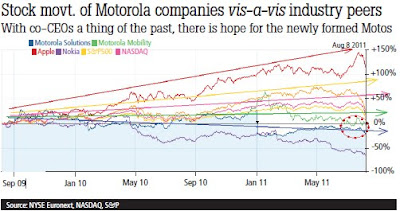
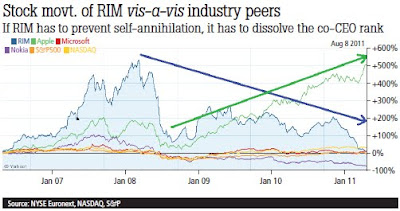
Look around – and you’ll easily find a plethora of visionless CEOs arbitrarily deciding which business areas should a company enter and which it should leave, without giving a glimmer of thought to whether their organisations have the wherewithal to succeed in chosen battlefield. The astoundingly mammoth list of failed M&As is evidence of the same. More evidence is provided by the speed with which CEOs are being eased out of their jobs – from Yahoo to Google to Tiger Airways to Wipro to RIM, from new-age to traditional industries, companies and CEOs seem to be deciding on new businesses based more on the “fools dare where...” ideology than basing the same on a logical and structured capability and competence advancement agenda. I usually write what my readers term ‘light stuff’ – easy on the eyes and amusing on the brain – and would have used this column to simply berate those organisations that don’t have structured plans to develop competencies and would have praised those that did. But I realized that even for an organisation that in all sincerity wants to set in motion a long term plan that could match its capabilities and vision, there practically exists no ‘readymade’ model that one could implement straight off the board to document one’s competencies. Worse, there’s no telling which competence fits where and is how important for future growth!
Guess what, for a change, I decided to ditch the ‘light stuff’ trademark and to go ahead and benchmark the methodology that is followed by the best in class to match vision with strengths, goals with skills, objectives with focused training – I call it the C2A2 model; in other words, the ‘Capabilities and Competencies Advancement Agenda’! Of course, the ‘C2A2’ term might seem pure limerick at its best, meant to invoke ‘term recall’ in the minds of the reader. But irrespective of the play of the term, the fact is that implementing such a competence development agenda in your organisation – whatever you call it, as long you have a process that does it – might just save your firm from getting decimated in the near future.
C2A2: AN IMPERATIVE FOR IMPLEMENTING STRATEGIC INTENTIONS
An imperative reason for corporations to take up the C2A2 model is the fact that immediately, the top management within the organisation is forced – or encouraged – to match their irreverent business vision (which may have been earlier propagated more due to their ego) with the competencies that are documented within the organisation. In other words, call it what you may, but even if you have documents floating around in various business of your organisation that have mapped out various strengths and weaknesses of those businesses, you’re well started already. But wait, there’s much more left – and that’s where I hit you with the jargon.
‘CAPABILITY MODULATION’ IN C2A2: KNOW YOUR HARDCAPS Vs. SOFTCAPS
Capabilities within any organisation should be visibly perceived in two basic forms, namely HardCaps and SoftCaps. Hard capabilities, or HardCaps, show themselves in the forms of visible ‘hard’ items that can be seen. For example, machinery, cash, personnel, number of patents et al, are HardCaps. Soft capabilities, or SoftCaps, show themselves up in the form of ‘soft’ items that cannot be necessarily seen, rather can be perceived. The backbone of any company’s strategic architecture is made up of the combination of HardCaps & SoftCaps. HardCaps can be quantified. But Hard Capabilities are ruled by Soft Capabilities and this is where the problem arises. It is much difficult to maintain and understand SoftCaps. Knowledge management, process manuals, ISO et al, are all attempts by any organisation to maintain a Hard interface on Soft Capabilities. The corollary is that SoftCaps are most difficult for competitors to replicate and hence can become the basis for extremely long sustainable competitive advantages. But a corporation cannot succeed on Soft- Caps alone. There has to be a most practicable combination of Soft Capabilities and Hard Capabilities for any company to succeed.
So how does one understand which ‘Caps’ is more important? And which less? And how does one know which capability does one need to develop and which to destroy? Differentiating your capabilities using the Structural Capabilities Architecture is one solution that provides the answers.
THE STRUCTURAL CAPABILITIES ARCHITECTURE
Structural Capabilities within any organisation belong to four categories. Doorway, Elemental, Enrichment and Power Leadership Capabilities. Once you have categorised each and every capability under these heads, you would automatically understand which ones you need to maintain, develop and which ones you need to leave go.
DOORWAY CAPABILITIES: These are essential capacities which allow entry of the organisation into targeted businesses/markets/ industries by dissolving entry barriers. These capabilities could relate to any of the functional areas (marketing, human resources, manufacturing, finance, research & development, legal, advertising et al). For example, any corporation wishing to enter the business of manufacturing aircraft needs to have all-encompassing financial capabilities, technology backup with respect to personnel, plant & machinery, necessary government licences, patent clarifications et al. Similarly, every industry has a set of Doorway Capabilities (Porter slantingly refers to these as Entry Barriers), which one has to obtain ‘before’ entering an industry. The simple corollary which most CEOs forget: if you don’t have Doorway Capabilities, it makes quite less sense to enter a new industry, however attractive it might be. Ergo, first document what Doorway Capabilities are required to enter an industry, then acquire those capabilities, and subsequently enter.
ELEMENTAL CAPABILITIES: These are capacities that, after an organisation has procured the Doorway Capabilities, sustain any organisation’s functioning on a day-to-day basis. When Barista took leadership of the narrow market of café sales through Barista stores all over, competitors were more moved by the glamour of it all, rather than the pure profit dynamics. Also-ran competitors did not realise that coffee parlours were not a source of industry leadership, but were rather only a source of industry survival and continuance (Elemental) capabilities. Duncans (a G. P. Goenka group company) went into setting up Barista style tea parlours in various East Indian territories with the collaboration of retail outlets like Pantaloon (Café Bollywood). At the same time, Café Coffee Day was bent on targeting the highest potential markets by opening up coffee parlours all over India. Even though Nestle also has Café Nescafe outlets all across relevant markets, Nestlé is the leader in the overall coffee segment (with HUL following in at second rank) not because of Café Nescafe coffee parlours, but thoroughly because of the focus on converting traditional supply chain channels (institutional sales, vending machines, retail sales et al) into ‘Enrichment capabilities’ (definition on next page). Nestle & HUL have clearly realised that in this industry, the maximum sales growth can occur only through leadership in traditional channels, rather than through fashionable outlets.

But wait, there are two groups of Elemental Capabilities – Pure & Derived.
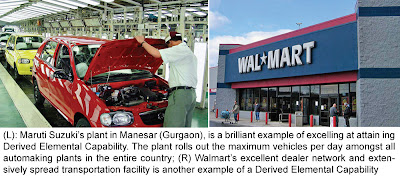
Derived Elemental Capabilities are those that are continuations & combinations of improved Doorway Capabilities. For example, for an automobile manufacturer, having a plant is a Doorway Capability, but continuing production in the plant is an Elemental Capability derived from already existing Doorway Capabilities like the plant, personnel, electricity availability etc. The fact that Maruti Suzuki India Limited’s plant in Manesar (Gurgaon), rolls out the maximum number of vehicles per day (1200 units, as of September 6, 2011) and has been attaining similar benchmarks for the past 14 years (since it started) is a brilliant example of excelling at attaining derived elemental capabilities. Setting up marketing channels are invaluable Doorway Capabilities for retail corporations to start operations; maintaining these marketing channels using a combination of Doorway Capabilities like sales personnel, dealer network, and transportation et al, is a Derived Elemental Capability. Globally, Walmart is an example of this.
The other group of Elemental Capabilities is known as Pure Elemental Capabilities. These are capabilities that have not been derived from Doorway Capabilities but have been developed or acquired anew. Having detailed customer query handling processes, in spite of not being Doorway Capabilities, are essential for almost all airlines and computer selling organisations for able day-to-day customer relationship management, thus becoming Pure Elemental Capabilities that should be acquired & developed by any computer organisation. Virgin Atlantic’s customer relationship management programme, being currently handled by loyalty marketing specialists ICLP (which also works with airline group Star Alliance and for several carriers like Cathay Pacific, Air New Zealand and Qatar Airways) is an example.
ENRICHMENT CAPABILITIES: Any capability that provides the basis for growth over and above the current standards of the organisation is known as an Enrichment Capability. Enrichment Capabilities are not about gaining leadership in the industry, neither are they about obtaining competitive advantage. Rather they are about gaining absolute growth in areas that are critical to the organisation. Jet Airways entered the Indian market in May 1993, and has since then, carried millions of passengers. Since the start of its operation, Jet was clinically involved with a radical focus on improvement of structural capabilities. It continuously attempted to upgrade the most critical structural capability, namely the aircraft fleet. In 2003, Jet Airways started with an operational fleet of 34 Boeing 737s and 8 ATR72-500 aircraft. Since then the airline has earned a reputation for “constantly maintaining its average fleet age below 10 years”, which is characterised by frequent phasing out of aircraft that exceed 10 years of age. As of May 2011, the average age of the airline’s fleet stood at just 5.4 years – the lowest in the industry! Today, the airline’s total fleet of 97 aircraft consists of 12 A330s, 55 B737s, 10 B777s and 20 ATR72s. Aircraft are nothing but Enrichment Capabilities for Jet, as growth of the airline increases with the number of aircraft acquired by Jet, ceterus paribus. In fact, today, despite not being at the top in terms of the number of aircraft in their fleet, Jet Airways has the largest market share of 25.5% (June 2011) and is the only profitable FSC (with a positive bottomline of Rs.96.9 million during FY2010-11) in the domestic market.

But wait. Even Enrichment Capabilities can be pure or derived.
The capabilities that have been derived from Elemental Capabilities are known as Derived Enrichment Capabilities.
For example, a food services organisation might believe after research and inference that improvement of the marketing channel reach might result in improvement of its market share. In this case, the organisation would attempt to Derive Enrichment Capabilities from the already existing Elemental Capabilities by combining factors like PR campaigns, advertising et al. The food services organisation might replicate this combination of its Elemental Capabilities in expanding marketing channels to other geographic regions, thus providing the much needed growth. For an automobile manufacturer, having a plant is a Doorway Capability, continuing production in the plant is an Elemental Capability, but improving production process efficiencies in order to be more cost effective are Derived Enrichment Capabilities. The other group of Enrichment Capabilities is known as Pure Enrichment Capabilities. These are capabilities that have not been derived from previous Capabilities but have been developed or acquired anew. Capability processes covering PR, market scanning & research, training & development, technology & capital asset acquisitions, research & development are all examples of capabilities that can take the form of Pure Enrichment Capabilities if directly acquired or taken over from the external environment. Brand takeovers, joint ventures, plant acquisitions, marketing channel purchases are all examples of Pure Enrichment Capabilities.
POWER LEADERSHIP CAPABILITIES (OR COMPETENCIES): Capabilities that provide the basis for gaining leadership and sustainable competitive advantages in various industries and markets – those that give you Power Brands too – are known as Power Leadership Capabilities or Competencies. This set is what a company should strive to maintain.
For example, becoming the lowest cost manufacturer in any industry could be a direct result of a previous Enrichment capability of cost effective manufacturing becoming extremely superior to those of competitors. Do not forget that this ‘cost effective manufacturing’ must have been obtained after combining various Elemental Capabilities like relevant training of personnel, process improvements & IT systems integration being refined to the highest degree and thus becoming a reason for industry leadership (see chart on previous page for progression). But this can be bought in one straight shot too!
Yes, Power Leadership Capabilities can also be obtained without necessarily goingthrough the progression of organic development of capabilities. M&As are typical examples of how companies attempt in one go to gain Power Leadership Capabilities external to the organisation by taking over targeted companies that have critical and strategically important assets, products, brands, structures and processes. But given the ever-present risk within M&As, it’s better (but not necessary) if Power Leadership Capabilities are developed organically within the organisation.
What I’ve attempted in this massively theoretical editorial is to tell you – the CEO – that the first step to becoming a world class organistion setting superlative benchmarks, is documenting a plan to know, maintain and develop your capabilities and competencies. And if you had no idea how to prepare that document, just blindly implement what I’ve presented here – and keep sending me the royalty.
Look around – and you’ll easily find a plethora of visionless CEOs arbitrarily deciding which business areas should a company enter and which it should leave, without giving a glimmer of thought to whether their organisations have the wherewithal to succeed in chosen battlefield. The astoundingly mammoth list of failed M&As is evidence of the same. More evidence is provided by the speed with which CEOs are being eased out of their jobs – from Yahoo to Google to Tiger Airways to Wipro to RIM, from new-age to traditional industries, companies and CEOs seem to be deciding on new businesses based more on the “fools dare where...” ideology than basing the same on a logical and structured capability and competence advancement agenda. I usually write what my readers term ‘light stuff’ – easy on the eyes and amusing on the brain – and would have used this column to simply berate those organisations that don’t have structured plans to develop competencies and would have praised those that did. But I realized that even for an organisation that in all sincerity wants to set in motion a long term plan that could match its capabilities and vision, there practically exists no ‘readymade’ model that one could implement straight off the board to document one’s competencies. Worse, there’s no telling which competence fits where and is how important for future growth!
Guess what, for a change, I decided to ditch the ‘light stuff’ trademark and to go ahead and benchmark the methodology that is followed by the best in class to match vision with strengths, goals with skills, objectives with focused training – I call it the C2A2 model; in other words, the ‘Capabilities and Competencies Advancement Agenda’! Of course, the ‘C2A2’ term might seem pure limerick at its best, meant to invoke ‘term recall’ in the minds of the reader. But irrespective of the play of the term, the fact is that implementing such a competence development agenda in your organisation – whatever you call it, as long you have a process that does it – might just save your firm from getting decimated in the near future.

C2A2: AN IMPERATIVE FOR IMPLEMENTING STRATEGIC INTENTIONS
An imperative reason for corporations to take up the C2A2 model is the fact that immediately, the top management within the organisation is forced – or encouraged – to match their irreverent business vision (which may have been earlier propagated more due to their ego) with the competencies that are documented within the organisation. In other words, call it what you may, but even if you have documents floating around in various business of your organisation that have mapped out various strengths and weaknesses of those businesses, you’re well started already. But wait, there’s much more left – and that’s where I hit you with the jargon.
‘CAPABILITY MODULATION’ IN C2A2: KNOW YOUR HARDCAPS Vs. SOFTCAPS
Capabilities within any organisation should be visibly perceived in two basic forms, namely HardCaps and SoftCaps. Hard capabilities, or HardCaps, show themselves in the forms of visible ‘hard’ items that can be seen. For example, machinery, cash, personnel, number of patents et al, are HardCaps. Soft capabilities, or SoftCaps, show themselves up in the form of ‘soft’ items that cannot be necessarily seen, rather can be perceived. The backbone of any company’s strategic architecture is made up of the combination of HardCaps & SoftCaps. HardCaps can be quantified. But Hard Capabilities are ruled by Soft Capabilities and this is where the problem arises. It is much difficult to maintain and understand SoftCaps. Knowledge management, process manuals, ISO et al, are all attempts by any organisation to maintain a Hard interface on Soft Capabilities. The corollary is that SoftCaps are most difficult for competitors to replicate and hence can become the basis for extremely long sustainable competitive advantages. But a corporation cannot succeed on Soft- Caps alone. There has to be a most practicable combination of Soft Capabilities and Hard Capabilities for any company to succeed.
So how does one understand which ‘Caps’ is more important? And which less? And how does one know which capability does one need to develop and which to destroy? Differentiating your capabilities using the Structural Capabilities Architecture is one solution that provides the answers.
THE STRUCTURAL CAPABILITIES ARCHITECTURE
Structural Capabilities within any organisation belong to four categories. Doorway, Elemental, Enrichment and Power Leadership Capabilities. Once you have categorised each and every capability under these heads, you would automatically understand which ones you need to maintain, develop and which ones you need to leave go.
DOORWAY CAPABILITIES: These are essential capacities which allow entry of the organisation into targeted businesses/markets/ industries by dissolving entry barriers. These capabilities could relate to any of the functional areas (marketing, human resources, manufacturing, finance, research & development, legal, advertising et al). For example, any corporation wishing to enter the business of manufacturing aircraft needs to have all-encompassing financial capabilities, technology backup with respect to personnel, plant & machinery, necessary government licences, patent clarifications et al. Similarly, every industry has a set of Doorway Capabilities (Porter slantingly refers to these as Entry Barriers), which one has to obtain ‘before’ entering an industry. The simple corollary which most CEOs forget: if you don’t have Doorway Capabilities, it makes quite less sense to enter a new industry, however attractive it might be. Ergo, first document what Doorway Capabilities are required to enter an industry, then acquire those capabilities, and subsequently enter.
ELEMENTAL CAPABILITIES: These are capacities that, after an organisation has procured the Doorway Capabilities, sustain any organisation’s functioning on a day-to-day basis. When Barista took leadership of the narrow market of café sales through Barista stores all over, competitors were more moved by the glamour of it all, rather than the pure profit dynamics. Also-ran competitors did not realise that coffee parlours were not a source of industry leadership, but were rather only a source of industry survival and continuance (Elemental) capabilities. Duncans (a G. P. Goenka group company) went into setting up Barista style tea parlours in various East Indian territories with the collaboration of retail outlets like Pantaloon (Café Bollywood). At the same time, Café Coffee Day was bent on targeting the highest potential markets by opening up coffee parlours all over India. Even though Nestle also has Café Nescafe outlets all across relevant markets, Nestlé is the leader in the overall coffee segment (with HUL following in at second rank) not because of Café Nescafe coffee parlours, but thoroughly because of the focus on converting traditional supply chain channels (institutional sales, vending machines, retail sales et al) into ‘Enrichment capabilities’ (definition on next page). Nestle & HUL have clearly realised that in this industry, the maximum sales growth can occur only through leadership in traditional channels, rather than through fashionable outlets.

But wait, there are two groups of Elemental Capabilities – Pure & Derived.
Derived Elemental Capabilities are those that are continuations & combinations of improved Doorway Capabilities. For example, for an automobile manufacturer, having a plant is a Doorway Capability, but continuing production in the plant is an Elemental Capability derived from already existing Doorway Capabilities like the plant, personnel, electricity availability etc. The fact that Maruti Suzuki India Limited’s plant in Manesar (Gurgaon), rolls out the maximum number of vehicles per day (1200 units, as of September 6, 2011) and has been attaining similar benchmarks for the past 14 years (since it started) is a brilliant example of excelling at attaining derived elemental capabilities. Setting up marketing channels are invaluable Doorway Capabilities for retail corporations to start operations; maintaining these marketing channels using a combination of Doorway Capabilities like sales personnel, dealer network, and transportation et al, is a Derived Elemental Capability. Globally, Walmart is an example of this.
The other group of Elemental Capabilities is known as Pure Elemental Capabilities. These are capabilities that have not been derived from Doorway Capabilities but have been developed or acquired anew. Having detailed customer query handling processes, in spite of not being Doorway Capabilities, are essential for almost all airlines and computer selling organisations for able day-to-day customer relationship management, thus becoming Pure Elemental Capabilities that should be acquired & developed by any computer organisation. Virgin Atlantic’s customer relationship management programme, being currently handled by loyalty marketing specialists ICLP (which also works with airline group Star Alliance and for several carriers like Cathay Pacific, Air New Zealand and Qatar Airways) is an example.
ENRICHMENT CAPABILITIES: Any capability that provides the basis for growth over and above the current standards of the organisation is known as an Enrichment Capability. Enrichment Capabilities are not about gaining leadership in the industry, neither are they about obtaining competitive advantage. Rather they are about gaining absolute growth in areas that are critical to the organisation. Jet Airways entered the Indian market in May 1993, and has since then, carried millions of passengers. Since the start of its operation, Jet was clinically involved with a radical focus on improvement of structural capabilities. It continuously attempted to upgrade the most critical structural capability, namely the aircraft fleet. In 2003, Jet Airways started with an operational fleet of 34 Boeing 737s and 8 ATR72-500 aircraft. Since then the airline has earned a reputation for “constantly maintaining its average fleet age below 10 years”, which is characterised by frequent phasing out of aircraft that exceed 10 years of age. As of May 2011, the average age of the airline’s fleet stood at just 5.4 years – the lowest in the industry! Today, the airline’s total fleet of 97 aircraft consists of 12 A330s, 55 B737s, 10 B777s and 20 ATR72s. Aircraft are nothing but Enrichment Capabilities for Jet, as growth of the airline increases with the number of aircraft acquired by Jet, ceterus paribus. In fact, today, despite not being at the top in terms of the number of aircraft in their fleet, Jet Airways has the largest market share of 25.5% (June 2011) and is the only profitable FSC (with a positive bottomline of Rs.96.9 million during FY2010-11) in the domestic market.

But wait. Even Enrichment Capabilities can be pure or derived.
The capabilities that have been derived from Elemental Capabilities are known as Derived Enrichment Capabilities.
For example, a food services organisation might believe after research and inference that improvement of the marketing channel reach might result in improvement of its market share. In this case, the organisation would attempt to Derive Enrichment Capabilities from the already existing Elemental Capabilities by combining factors like PR campaigns, advertising et al. The food services organisation might replicate this combination of its Elemental Capabilities in expanding marketing channels to other geographic regions, thus providing the much needed growth. For an automobile manufacturer, having a plant is a Doorway Capability, continuing production in the plant is an Elemental Capability, but improving production process efficiencies in order to be more cost effective are Derived Enrichment Capabilities. The other group of Enrichment Capabilities is known as Pure Enrichment Capabilities. These are capabilities that have not been derived from previous Capabilities but have been developed or acquired anew. Capability processes covering PR, market scanning & research, training & development, technology & capital asset acquisitions, research & development are all examples of capabilities that can take the form of Pure Enrichment Capabilities if directly acquired or taken over from the external environment. Brand takeovers, joint ventures, plant acquisitions, marketing channel purchases are all examples of Pure Enrichment Capabilities.
POWER LEADERSHIP CAPABILITIES (OR COMPETENCIES): Capabilities that provide the basis for gaining leadership and sustainable competitive advantages in various industries and markets – those that give you Power Brands too – are known as Power Leadership Capabilities or Competencies. This set is what a company should strive to maintain.
For example, becoming the lowest cost manufacturer in any industry could be a direct result of a previous Enrichment capability of cost effective manufacturing becoming extremely superior to those of competitors. Do not forget that this ‘cost effective manufacturing’ must have been obtained after combining various Elemental Capabilities like relevant training of personnel, process improvements & IT systems integration being refined to the highest degree and thus becoming a reason for industry leadership (see chart on previous page for progression). But this can be bought in one straight shot too!
Yes, Power Leadership Capabilities can also be obtained without necessarily goingthrough the progression of organic development of capabilities. M&As are typical examples of how companies attempt in one go to gain Power Leadership Capabilities external to the organisation by taking over targeted companies that have critical and strategically important assets, products, brands, structures and processes. But given the ever-present risk within M&As, it’s better (but not necessary) if Power Leadership Capabilities are developed organically within the organisation.
What I’ve attempted in this massively theoretical editorial is to tell you – the CEO – that the first step to becoming a world class organistion setting superlative benchmarks, is documenting a plan to know, maintain and develop your capabilities and competencies. And if you had no idea how to prepare that document, just blindly implement what I’ve presented here – and keep sending me the royalty.